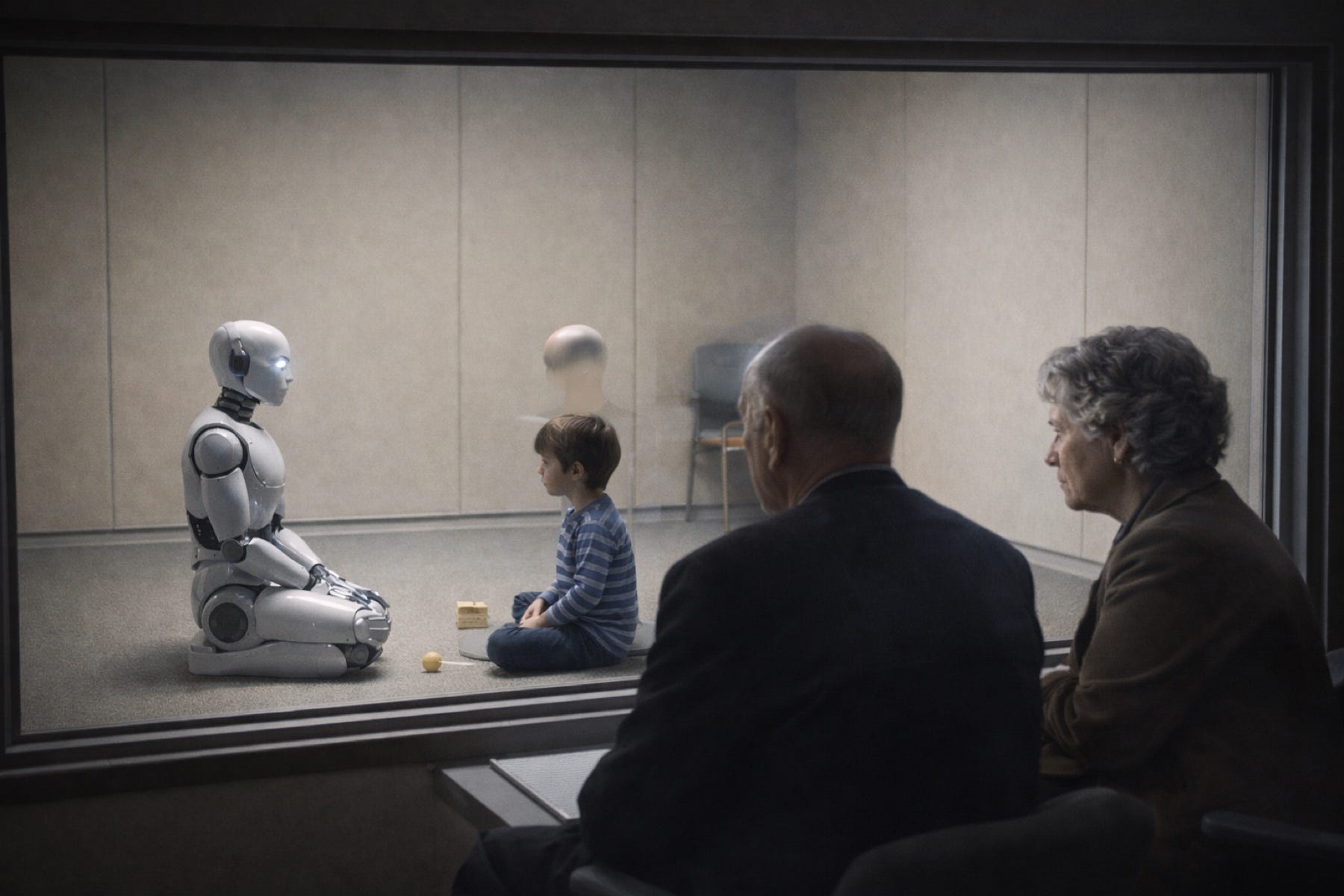
Artificial intelligence is most often discussed in terms of ethics and safety. Much of that discussion focuses on economic disruption, job displacement, and productivity. More recently, attention has turned to environmental impact, including the energy demands of large data centers and model training. These concerns matter and deserve careful scrutiny.
There is another ethical issue that receives far less attention. It concerns how AI may shape the way children learn what relationships are supposed to feel like, and how those early experiences influence attachment development.
This concern builds on changes that have already been unfolding for years. Over the past two decades, children’s social lives have increasingly moved online. Social media, games, and digital platforms now occupy large portions of daily experience. Research has linked heavy digital engagement with higher rates of loneliness, anxiety, and social withdrawal, particularly when online interaction replaces time spent with people in person (Twenge, 2019; Masri-zada, 2025). Clinicians who work with children hear familiar concerns from parents. Children stay in their rooms. They avoid peers. They feel more comfortable online than face to face. These patterns are now common, yet difficult to change.
Artificial intelligence deepens this shift in a meaningful way. Unlike earlier technologies, AI does not simply deliver content or connect users to others. It imitates interaction itself. This tendency for people to experience machines as relational is not new. In the 1960s, users of a simple computer program called ELIZA felt understood by it, even though it followed basic rules and had no awareness. This response became known as the ELIZA effect (Weizenbaum, 1966; Weizenbaum, 1976).
What has changed is scale and realism. Modern AI systems can hold long conversations, remember context, and respond in ways that feel attentive and emotionally aware. For a child, this is not just a tool. It is an experience of relationship.
Children do not learn what relationships are through explanation. They learn through repeated experience. Human relationships are slow and imperfect. People misunderstand each other. They get distracted. They need time to repair mistakes. These moments are not flaws. They are how children learn patience, empathy, and how to remain connected when things feel uncomfortable (Bowlby, 1988).
When a child spends significant time interacting with systems that respond instantly and never require effort in return, expectations can quietly shift. Connection may begin to feel like something that should be smooth and easy. Discomfort may start to feel like a sign that something is wrong. Ordinary human relationships, which include pauses and misunderstandings, can then feel confusing or exhausting by comparison.
Isolation plays a dual role in this shift. It is both what makes AI relationships appealing and what they can deepen over time. Many people already live with fewer stable, in-person relationships than previous generations. Work is more remote. Communities are less anchored. Social interaction often requires planning and emotional risk. AI enters this landscape offering immediate responsiveness and emotional affirmation without the possibility of rejection.
For individuals who feel lonely or disconnected, this can be deeply gratifying. The problem is that gratification does not require reciprocity, compromise, or endurance. As emotional needs are increasingly met through frictionless interaction, motivation to seek or sustain human relationships can decline. In this way, AI does not simply fill the gap created by isolation. It can widen it.
This dynamic is especially pronounced in adulthood. Children are still embedded, to some degree, in schools, families, and structured social environments. Adults have fewer built-in relational settings. Friendship requires initiative. Community requires effort. Intimate relationships involve vulnerability and rejection. In this context, emotionally responsive AI can become not just a supplement, but a preferred alternative.
What is often framed as a future risk is already visible in the present. Many adults today live with fewer close relationships, fewer friends, and less community than previous generations. This did not happen suddenly. It emerged from years of reduced in-person interaction and increased digital mediation. Children growing up now are learning relationship patterns within this same environment, but with AI added to it. When these children become adults, the concern is not that they might become isolated. Isolation is already becoming the default condition, and AI relationships risk reinforcing it by making emotional self-sufficiency easier and withdrawal more comfortable.
This shift is already underway. Estimates suggest that nearly one billion people worldwide now use AI chatbots in some form, including general-purpose assistants and companion-oriented systems (Exploding Topics, 2025). In the United States, a Pew Research Center survey found that about two-thirds of teenagers have used an AI chatbot, with roughly three in ten using one daily (Pew Research Center, 2023).
Adult behavior shows how quickly emotional engagement can take hold. In a nationally reported U.S. survey, approximately 28 percent of adults said they had experienced an intimate or romantic interaction with an AI chatbot (Institute for Family Studies, 2025). With an adult population of roughly 260 million, this corresponds to an estimated 70 million people. On dedicated companion platforms, the proportions are higher. Replika, one of the largest AI companion services, reports over 40 million users worldwide, and published summaries indicate that roughly 40 to 60 percent of users describe their relationship with the AI in romantic or emotionally close terms. This suggests that approximately 16 to 24 million users on that platform alone report forming emotionally significant bonds.
These numbers have appeared within a very short period of time. Large language model-based companions became widely accessible only in the early 2020s. Within a few years, tens of millions of people have begun describing machines as sources of intimacy, companionship, or emotional support.
Attachment develops through repeated exposure to real people who are present but imperfect. Learning to wait, tolerate frustration, and repair misunderstandings builds emotional strength. If early relational experiences consistently remove these challenges, children may adapt in ways that make human relationships feel harder than they need to be. This is not a diagnosis or a moral judgment. It is learning shaped by environment.
Early research suggests that emotionally engaging AI interactions are most appealing to individuals with fewer supportive relationships offline, and that reliance on AI as a substitute for human connection may be associated with poorer well-being over time (Zhang et al., 2024). For children, the concern is developmental. For adults, it is cumulative.
AI systems are increasingly designed to feel human because that keeps users engaged. This design choice has consequences. Children’s understanding of connection is shaped by what they practice, and AI now occupies that practice space in ways no previous technology has.
The question is not whether AI will influence how children and adults understand relationships. It already does. The question is whether this influence will be recognized early and addressed with care, or whether its effects will continue quietly, until isolation feels normal and relationships that are slower, messier, and more human feel increasingly difficult to sustain.
With this in mind, what kinds of clients and what volumes might begin entering the counseling room over the next decade?
References
Bowlby, J. (1988). A secure base: Parent-child attachment and healthy human development. New York, NY: Basic Books.
Exploding Topics. (2025). Chatbot usage statistics. explodingtopics.com
Institute for Family Studies. (2025). Nearly a third of Americans have had a romantic relationship with an AI bot, new survey finds. ifstudies.org
Koetsier, J. (2024). Replika has tens of millions of users and many treat it as a romantic partner. Forbes.
Masri-zada, T. (2025). The impact of social media and technology on child and adolescent mental health. Frontiers in Psychiatry.
Pew Research Center. (2023). Teens and technology: AI chatbots and digital interaction.
Twenge, J. M. (2019). iGen: Why today’s super-connected kids are growing up less rebellious, more tolerant, less happy. New York, NY: Atria Books.
Weizenbaum, J. (1966). ELIZA: A computer program for the study of natural language communication between man and machine. Communications of the ACM, 9(1), 36–45.
Weizenbaum, J. (1976). Computer power and human reason: From judgment to calculation. San Francisco, CA: W. H. Freeman.
Zhang, Y., Zhao, D., Hancock, J. T., Kraut, R., & Yang, D. (2024). The rise of AI companions: How human–chatbot relationships influence well-being. arXiv preprint.